

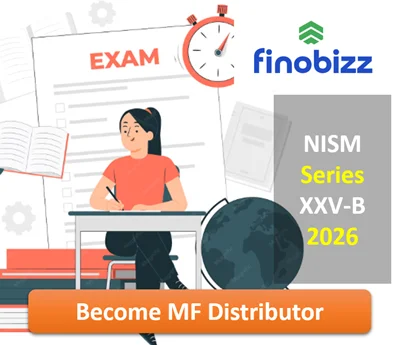
NISM Series XXV-B is the 2026 certification created for Persons Associated with Investment Advice (PAIA) who perform sales and other non-core functions inside a Registered Investment Adviser setup.
It is a lighter role-specific alternative for eligible non-core staff; it is not a shortcut for the people who actually perform investment-advice functions.
SEBI issued the PAIA relaxation circular on 24 June 2026, following NISM’s launch of XXV-B from 1 June 2026.
The change matters for RIA firms because relationship management, business development, and client-service roles do not always require the same depth as the adviser/principal officer performing the regulated advisory function.
Quick answer
Current XXV-B: ₹1,500 listed fee, 50 MCQs, 60 minutes, 50% pass (25 marks), no negative marking, online/remotely proctored and 3-year validity. It is only for PAIA staff doing sales and other non-core services.
What this Article Covers
- What XXV-B is
- Why SEBI introduced it
- Who is a PAIA
- Core advice vs sales/non-core
- Who should take XXV-B
- Exam details
- Curriculum weightage
- Remote-proctored registration
- Study plan
- PAN/validity/renewal
- XXV-B vs X-A/X-B
- RIA staffing controls
- FAQs
Who Is XXV-B For?
NISM says XXV-B caters only to Persons Associated with Investment Advice who perform sales and other non-core services.
SEBI’s circular describes the intended group as staff such as sales staff, relationship managers, and other employees who contact clients but are not directly associated with or involved in investment-advice-related activities.
Core Advice vs Non-Core Role
| Activity | Certification Direction |
| Preparing or delivering personalised investment advice | Core IA certification/qualification framework – not XXV-B alone |
| Risk profiling/suitability decisions forming the advice | Core advice function; use applicable IA certification architecture |
| Portfolio/asset-allocation recommendation to client | Core advice function |
| Explaining RIA service/fee proposition without advising | Sales/non-core – XXV-B framework |
| Client relationship follow-up / CRM | Sales/non-core – XXV-B framework |
| Business development/networking | Sales/non-core – XXV-B framework |
Exam Structure
| Particular | XXV-B 2026 |
| Launch | 1 June 2026 |
| SEBI relaxation circular | 24 June 2026 |
| Current listed fee | ₹1,500 plus payment-gateway/applicable charges as shown by NISM |
| Questions | 50 MCQs × 1 mark |
| Duration | 60 minutes |
| Pass mark | 25 / 50 (50%) |
| Negative marking | None |
| Mode | Internet-based, remotely proctored |
| Study material | NISM video-based content |
| Certificate validity | 3 years |
| Renewal | Reappear and pass before expiry |
| PAN | Required/updated for certificate issuance |
Curriculum and Weightage
| Session | Topic | Marks |
| 1 | Introduction to Personal Financial Planning and Financial Markets | 6 |
| 2 | Securities Markets & Basics of Investment | 6 |
| 3 | Financial Asset Classes | 8 |
| 4 | Financial Products | 8 |
| 5 | Sales Skills | 12 |
| 6 | Professionalism, Ethics and Compliance | 10 |
| Total | 50 |
The syllabus is deliberately broader than pure selling.
A relationship manager in an RIA should understand risk profiling, asset allocation, equity/debt/derivatives, mutual funds, PMS, AIFs, SIFs, retirement/insurance products, fiduciary responsibility and the difference between advisory sales and product selling.
How to Register
- Create/login to the NISM certification portal.
- Select NISM Series XXV-B.
- Update personal and PAN details.
- Review the remote-proctored exam instructions and system requirements.
- Pay the current exam fee.
- Use NISM’s free study/video material.
- Schedule and complete the remote assessment.
How to Prepare Efficiently
| Priority | Area | Reason |
| High | Sales skills | 12/50 marks; client profiling, advisory-based sales, communication, negotiation, CRM |
| High | Professionalism, ethics and compliance | 10/50; fiduciary responsibility and RIA role boundaries |
| High | Financial asset classes + products | 16/50 combined; adviser sales staff must understand what clients are discussing |
| Medium | Financial planning and securities basics | 12/50 combined; foundation for client conversations |
5-Day Preparation Plan
| Day | Focus |
| 1 | Financial planning, risk profiling and financial markets |
| 2 | Securities basics, risk-return, compounding, asset allocation and rebalancing |
| 3 | Equity, debt, derivatives + financial products (MF/PMS/AIF/SIF/retirement/insurance) |
| 4 | Sales skills, client profiling, communication, negotiation, CRM |
| 5 | Ethics, fiduciary duty, compliance, role boundaries + full revision |
XXV-B vs NISM X-A and X-B
| Feature | XXV-B | X-A / X-B Framework |
| Role | Sales and non-core PAIA staff | Core investment-advice roles |
| Depth | Foundational/advisory-sales knowledge | Deeper advisory competency |
| Questions | 50 | Different full certification structure |
| Pass | 50% | See current X-A/X-B exam rules |
| Negative marking | None | Current core exams have their own marking rules |
| Use | Role-specific lighter module | Not replaced for core advice by XXV-B |
Employer Controls
- Document each PAIA job description.
- Separate sales scripts from personalised investment advice.
- Do not let an XXV-B-only employee independently create recommendations or suitability decisions.
- Map client communications to the registered RIA identity.
- Maintain certificate number/expiry register.
- Reassess certification when the employee’s job changes.
- Train sales staff on fee disclosures, conflicts, fiduciary standards and escalation.
FAQs
Does XXV-B make someone an Investment Adviser?
No. It is a certification for eligible PAIA sales/non-core staff inside the regulated advisory framework.
Can an XXV-B holder give personalised investment advice?
The lighter certificate is not intended to replace the certification/qualification required for people directly involved in investment advice.
What is the current exam fee?
NISM’s live page/FAQ lists ₹1,500 plus payment-gateway/applicable charges.
Is there negative marking?
No.
How long is the certificate valid?
Three years.
Final Takeaway
XXV-B gives RIA firms a practical staffing model: core advice stays with properly qualified/certified advisory personnel while relationship and sales staff learn enough about markets, products, ethics and advisory conduct to communicate responsibly without pretending to be the adviser.